
- ← ALL BLOG ARTICLES
What happened to the woods we used to specify?
SPECIES & MARKET TRENDS
Richard Harris
November 9, 2026
Spend enough years walking through veneer warehouses, and you notice that the aroma of oak is stronger than it used to be.
There was a time when everyone wanted American cherry. That warm, reddish glow, deepening with age, filled boardrooms, kitchens and hotel lobbies. Beech was the honest workhorse of European furniture. Maple gave you that clean, pale, modern look.
Walk into most specifications today and you’ll see oak. Then walnut. Then more oak.
Most of us in the trade have felt this shift. The question is whether the numbers back it up. Broadly, they do, though the picture is less tidy than the feeling.
Danzer, one of the largest veneer producers in the world, publishes a breakdown of its sales by species. Comparing 2014 with 2024 makes for striking reading.
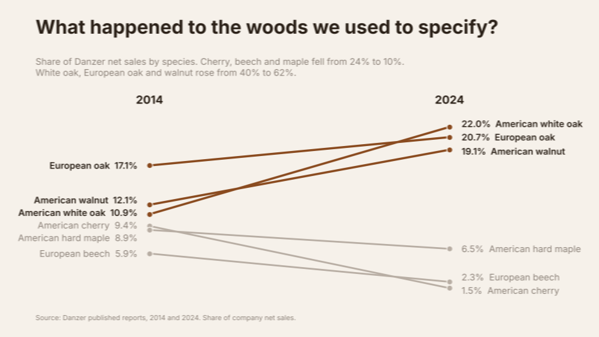
Species mix in Danzer net sales, 2014 and 2024. Source: Danzer published reports.
American cherry fell from 9.4% of sales to 1.5%. European beech dropped from 5.9% to 2.3%. Hard maple slipped from 8.9% to 6.5%. Together, those three went from almost a quarter of the business to about a tenth.
Over the same period, American white oak doubled from 10.9% to 22%. European oak and American walnut both climbed. Those three now account for more than 60% of sales.
Even oak isn’t one story, though. American red oak barely moved, staying at about 6% throughout. The market didn’t fall in love with oak. It fell in love with a particular kind of oak.
Tropical veneer tells a similar story with a twist. Ghana’s Forestry Commission reports sliced veneer exports separately, and between 2022 and 2024 they fell by more than a third. Mahogany almost disappeared, dropping from 752 cubic metres to 133. Anigre halved.
But obeche went the other way, rising by around half in a shrinking market.
The destinations are just as mixed. Shipments to Italy more than halved. Germany fell too. Denmark, on the other hand, roughly doubled. There’s no neat story here of Europe declining and Asia taking up the slack. Each market is moving in its own direction.
So what’s actually going on? Fashion is the obvious answer, and it’s surely part of it. But a species can lose share simply because another one grows faster. Exports can fall because logs are harder to get, prices have risen, or furniture factories are quieter. A supplier’s sales mix can’t tell you whether cherry has found new customers somewhere else.
What we can say with confidence is that species that once sat at the heart of the trade have had very different decades. Demand has concentrated around a small group of woods, and the rest have been left to fight for what remains.
That has consequences. When everyone specifies the same few species, those logs get more expensive and harder to secure. Some beautiful, perfectly suitable timbers go overlooked, and the people who know how to cut and match them get fewer chances to do it. Interiors start to look the same from London to Dubai.
None of this is a complaint about oak or walnut. Both are wonderful, and there are good reasons they’re popular. But it’s worth asking whether we’re choosing them, or just reaching for them out of habit.
For designers, specifiers and buyers, that might mean asking your supplier what else would work for a project, rather than starting with what worked last time. For those of us in supply, it might mean sending out a cherry or maple sample now and then and seeing who bites.
Trends turn. Cherry was the safe choice once. One day, someone will specify it and it will look fresh again.
So, a question for anyone who buys, specifies or sells veneer: which species have disappeared from your order book, and what took their place?