
There has always been a bit of romance in the veneer trade.
Spend any time around it and you’ll hear the stories. The figured walnut from an old estate in France. The burr that came out of some remote forest and was almost impossible to get hold of. The log a buyer travelled halfway round the world to see, and knew was special the moment he laid eyes on it.
Some of those stories were exactly true. Some grew a little with each telling. Either way, they were part of what made the material special. A sheet of veneer was never just a sheet of veneer. It came with a tale of where it began.
That tale is now being written into the paperwork.
On 30 December, the EU Deforestation Regulation (EUDR) comes into force. After two postponements and plenty of debate, the date now looks fixed, and veneer is squarely within its scope.
At its heart, EUDR asks a simple question: where did this wood come from, and can you prove it?
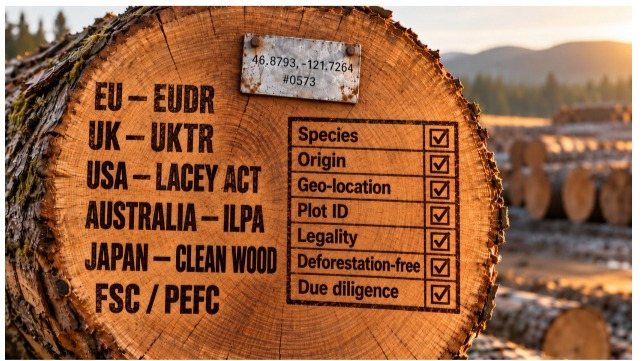
“A forest in the middle of somewhere” won’t be enough to answer it. Businesses placing timber on the EU market must show it was legally harvested and grown on land that hasn’t been deforested since the end of 2020. That means knowing the species, the date of harvest and the location of the actual plot of land where the tree grew.
In other words, the story behind the wood now needs coordinates.
This isn’t just a European issue. A UK supplier selling veneer into Europe may not be the one filing the paperwork, because that responsibility usually sits with the first EU business to bring the product onto the market. But that business can’t comply without information from further up the chain. The same goes for a mill in Malaysia, a log yard in Pennsylvania or a slicer in West Africa. The law is European. Its reach is global.
And EUDR doesn’t stand alone. The UK has its own Timber Regulation, which the government has said it intends to strengthen. The US has the Lacey Act, with import declarations that keep expanding. Australia tightened its illegal logging rules last year. FSC and PEFC certification have been pushing traceability through the industry for decades.
These are different countries with different systems, but they all point the same way, and none of them is going backwards. Whether you see that as progress or red tape, it’s now a fact of life.
There will be pain, and it’s worth being honest about that. Gathering this kind of data across long, multi-layered supply chains is hard. Smaller mills and merchants will feel the cost of systems, staff time and documentation most. Some perfectly legitimate suppliers, in parts of the world where record-keeping is patchy, may struggle to produce information in the form now required. Their timber may be fine while their paperwork isn’t. The first year will probably bring friction, delays and some expensive lessons.
But there’s little to be gained from resisting it. The rules are written, the dates are set, and customers are already starting to ask the questions.
So the sensible move is to get ahead of it. Know your supply chain, all the way back. Talk to your suppliers now about what information they can realistically provide. Talk to your customers, particularly in Europe, about what they’ll need from you. And build systems that can cope with today’s rules and with whatever comes next, because more is almost certainly on the way.
The businesses that do this early will be easier to buy from. Those that wait may find the conversation has moved on without them.
For years, buying veneer meant asking about species, cut, grade, colour and price, with the story of where it came from shared over the sample table. Now that story is becoming part of the specification.
Perhaps a little of the mystery goes with that. But a walnut log from a named valley is no less beautiful for being on a map. The romance hasn’t left the trade. It just has to come with the paperwork now.